Fly-Scan Trigger System
Continuous-motion, hardware-triggered acquisition — a rotation stage clocks the DAQ so every data point lands at an exact angle.
Python · Zaber motion control · NI-DAQmx · photodiode detection — source private
Instead of the classic move–stop–measure loop, this system measures on the fly: a rotation stage sweeps at constant velocity while its controller emits a hardware trigger at exact angular intervals, and those edges clock a National Instruments DAQ so each sample lands at a known angle. The result is dramatically faster angle-resolved measurements with no settling time.
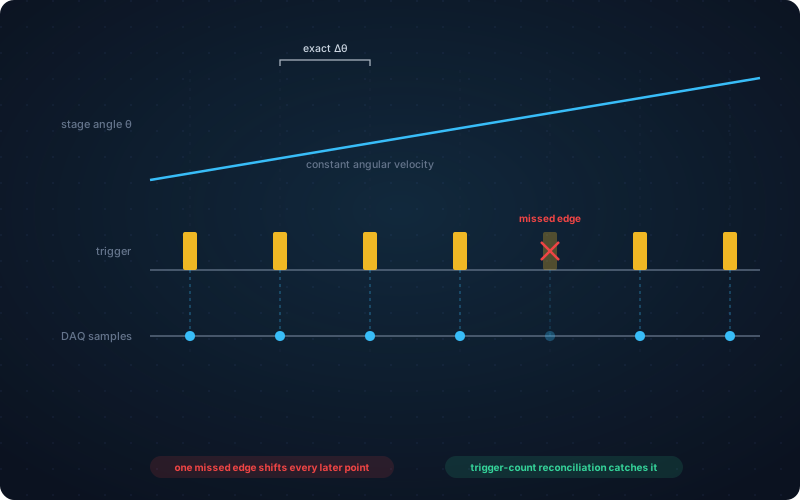
Measure on the move: trigger edges at exact angles clock the DAQ — and a single missed edge would shift every later point.
The subtle engineering is in trust: when the angle axis is derived from trigger counting, a single missed or phantom edge silently shifts every subsequent point. I root-caused that fragility and designed the hardening plan — trigger-count reconciliation against expected edges, an averaged acquisition mode where the DAQ free-runs and a counter tags edge positions for post-scan alignment, deterministic hardware start-triggering, and validation that models the detector’s gain-dependent bandwidth instead of just the stage’s limits. Also the fail-safe rule that shows up everywhere in my work: refuse loudly rather than silently zero-fill when a calibration input is out of range.